United Nations Children’s Fund (UNICEF): Complete UPSC Notes for Prelims & Mains
Jul 14, 2026
United Nations Children’s Fund (UNICEF): Complete UPSC Notes for Prelims & Mains
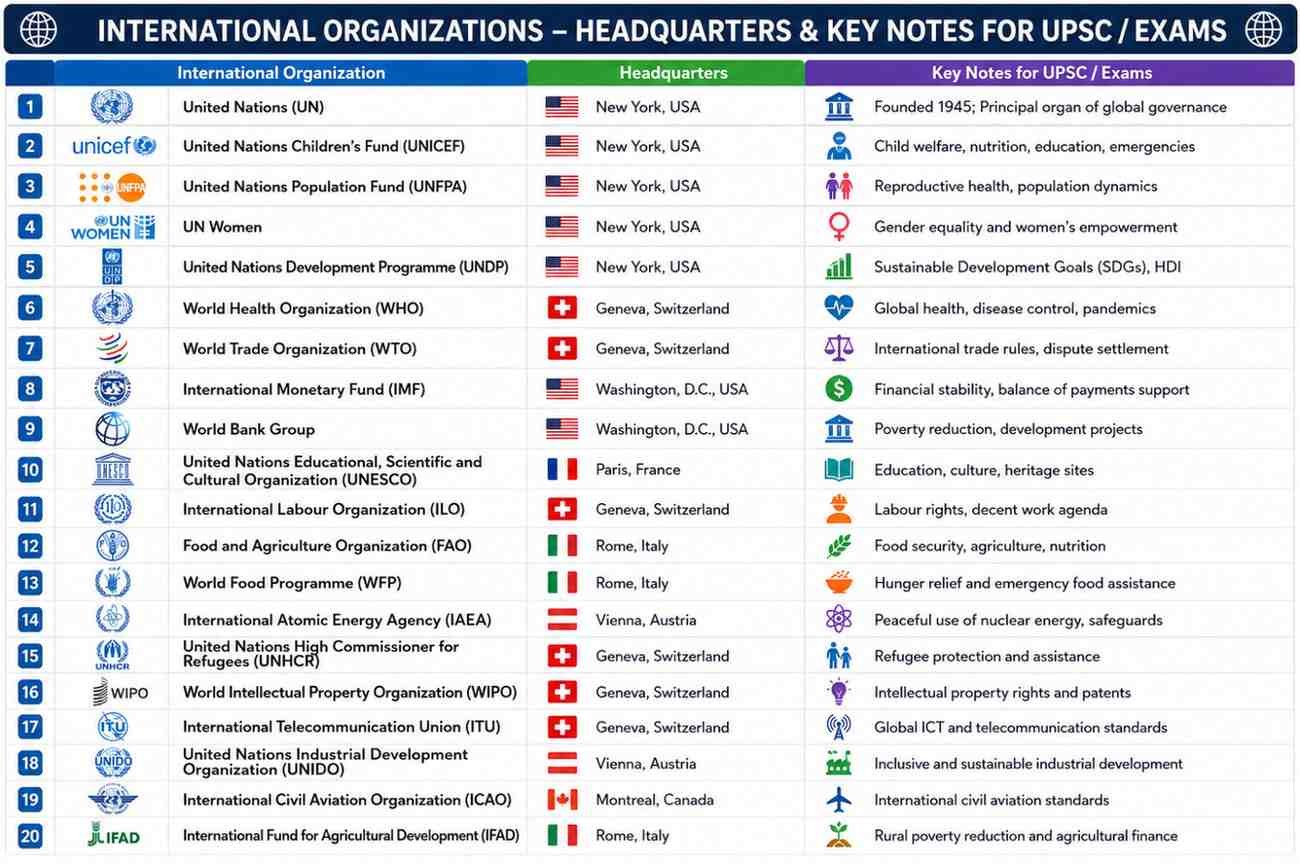
The United Nations Children’s Fund (UNICEF) is a vital specialized agency of the United Nations and a high-yield topic for UPSC Civil Services Exam (Prelims GS Paper 1 and Mains GS Paper 2 – International Relations & Social Justice). Questions are frequently asked on its mandate, functions, headquarters, and India’s partnership with UNICEF.
Introduction
UNICEF is the United Nations agency dedicated to protecting and promoting the rights of children worldwide. It works in over 190 countries to provide humanitarian and developmental assistance to children and mothers.
- Full Form: United Nations Children’s Fund (formerly United Nations International Children’s Emergency Fund)
- Established: 11 December 1946
- Headquarters: New York, USA
- Current Executive Director: Catherine Russell (USA, since 2022)
- Nobel Prize: UNICEF was awarded the Nobel Peace Prize in 1965 for promoting brotherhood among nations.
Historical Background
- Created by the UN General Assembly in the aftermath of World War II to provide emergency relief to children in war-torn Europe.
- In 1953, it became a permanent part of the UN system and changed its name to United Nations Children’s Fund, reflecting its broader, long-term developmental focus.
Mandate and Core Objectives
UNICEF operates on the principle of the Convention on the Rights of the Child (CRC), 1989 — the most widely ratified human rights treaty in history.
Key Areas of Work:
- Child survival and health (immunization, nutrition, maternal health)
- Quality education and early childhood development
- Child protection (against violence, exploitation, trafficking, child labour)
- WASH (Water, Sanitation and Hygiene)
- Emergency response and humanitarian action (conflict, disasters, pandemics)
- Adolescent development and participation
- Gender equality and inclusion
Organizational Structure
- Executive Board: Governs UNICEF; consists of 36 member states elected by ECOSOC.
- Works through Country Offices, Regional Offices, and National Committees (in 34 developed countries for fundraising).
- Funded entirely by voluntary contributions from governments, private sector, and individuals (top donors include USA, Germany, UK, Japan, and the European Commission).
UNICEF and India
India is one of the largest and most important partners of UNICEF.
- UNICEF has been working in India since 1949.
- Focus areas in India: Polio eradication (India declared polio-free in 2014), nutrition (POSHAN Abhiyaan), education (especially girls), child protection, and sanitation (Swachh Bharat linkage).
- Supports flagship government schemes like Beti Bachao Beti Padhao, Mid-Day Meal, and National Health Mission.
- Helps in data collection through surveys like NFHS (National Family Health Survey).
Achievements in India:
- Significant reduction in Infant Mortality Rate (IMR) and Maternal Mortality Ratio (MMR).
- Improved access to vaccines and clean drinking water.
- Response during COVID-19: Provided essential supplies, supported remote learning, and protected children from violence.
Global Impact and Challenges
Major Achievements:
- Contributed to dramatic decline in under-5 mortality globally.
- Vaccination of millions of children against measles, polio, etc.
- Humanitarian response in crises (Syria, Ukraine, Gaza, natural disasters).
- Advocacy for children’s rights leading to global policy changes.
Challenges:
- Rising conflicts and climate change affecting children disproportionately.
- Funding gaps and increasing humanitarian needs.
- Issues like child marriage, malnutrition, and digital divide.
Relevance for UPSC
- Prelims: Headquarters, establishment year, Nobel Prize, full form.
- Mains: Role in sustainable development, child rights, India-UNICEF partnership, linkages with SDGs (especially Goal 3, 4, 5, 16).
- Essay/Interview: Child-centric development, future of multilateralism in child welfare.
Key Facts to Remember:
- UNICEF works in 190+ countries.
- Focus on equity: Reaching the most disadvantaged children.
- India is both a recipient and increasingly a development partner (South-South cooperation).
Conclusion UNICEF remains the world’s leading advocate for children, embodying the UN’s commitment to a better future for the youngest generation. For India, strengthening collaboration with UNICEF is crucial to achieving the vision of Viksit Bharat and ensuring “no child is left behind.”
UPSC Revision Tip: Prepare short notes on major UN agencies (UNICEF, UNDP, UNHCR, WHO) together for comparison. Always link with current affairs like global child nutrition reports, education in emergencies, or India’s G20 initiatives on children.
This structured article on UNICEF serves as complete ready-to-revise notes for UPSC CSE and State PSC examinations. For similar notes on other international organizations (UN, WHO, UNESCO, etc.), explore the International Relations section.
Save, revise, and share with fellow aspirants!