United Nations (UN): Complete UPSC Notes – Origin, Structure, Functions, and India’s Role
Jul 14, 2026
United Nations (UN): Complete UPSC Notes – Origin, Structure, Functions, and India’s Role
The United Nations (UN) is one of the most important international organizations asked in UPSC Civil Services Examination (Prelims and GS Paper 2 – International Relations). Questions frequently appear on its organs, specialized agencies, reforms, and India’s engagement with the UN. This article provides comprehensive, exam-oriented notes in a structured UPSC-friendly format.
Introduction
The United Nations is a global intergovernmental organization established to maintain international peace and security, promote cooperation among nations, and foster social and economic development. It is the largest and most influential multilateral forum in the world today.
- Established: 24 October 1945 (UN Day is celebrated annually on this date)
- Headquarters: New York, USA
- Membership: 193 Member States (as of 2026)
- Official Languages: Arabic, Chinese, English, French, Russian, Spanish
- Motto: “Peace, Dignity and Equality on a Healthy Planet”
The UN was founded in the aftermath of the Second World War to replace the ineffective League of Nations and prevent future global conflicts.
Historical Background
- The term “United Nations” was coined by Franklin D. Roosevelt.
- The Atlantic Charter (1941) by Roosevelt and Churchill laid the groundwork.
- The Dumbarton Oaks Conference (1944) and San Francisco Conference (1945) finalized the UN Charter.
- The UN Charter was signed on 26 June 1945 and came into force on 24 October 1945.
Preamble of the UN Charter highlights the purposes: to save succeeding generations from the scourge of war, reaffirm faith in fundamental human rights, and promote social progress.
Principal Organs of the United Nations
The UN has six principal organs as per the Charter:
- General Assembly (UNGA)
- Largest deliberative body; all members have one vote.
- Meets annually in September.
- Elects non-permanent members of Security Council and Secretary-General.
- Security Council (UNSC)
- Primary responsibility for maintenance of international peace and security.
- 15 members: 5 Permanent (P5 – USA, Russia, China, UK, France) with Veto power + 10 Non-permanent.
- India has been elected as non-permanent member 8 times (most recent 2021-22).
- Economic and Social Council (ECOSOC)
- Coordinates economic, social, and environmental work.
- 54 members elected for 3-year terms.
- Trusteeship Council
- Suspended operations since 1994 after decolonization.
- International Court of Justice (ICJ)
- Principal judicial organ, located at The Hague, Netherlands.
- Settles disputes between states.
- Secretariat
- Headed by the Secretary-General (currently António Guterres, Portugal – re-elected in 2021).
- Administrative arm of the UN.
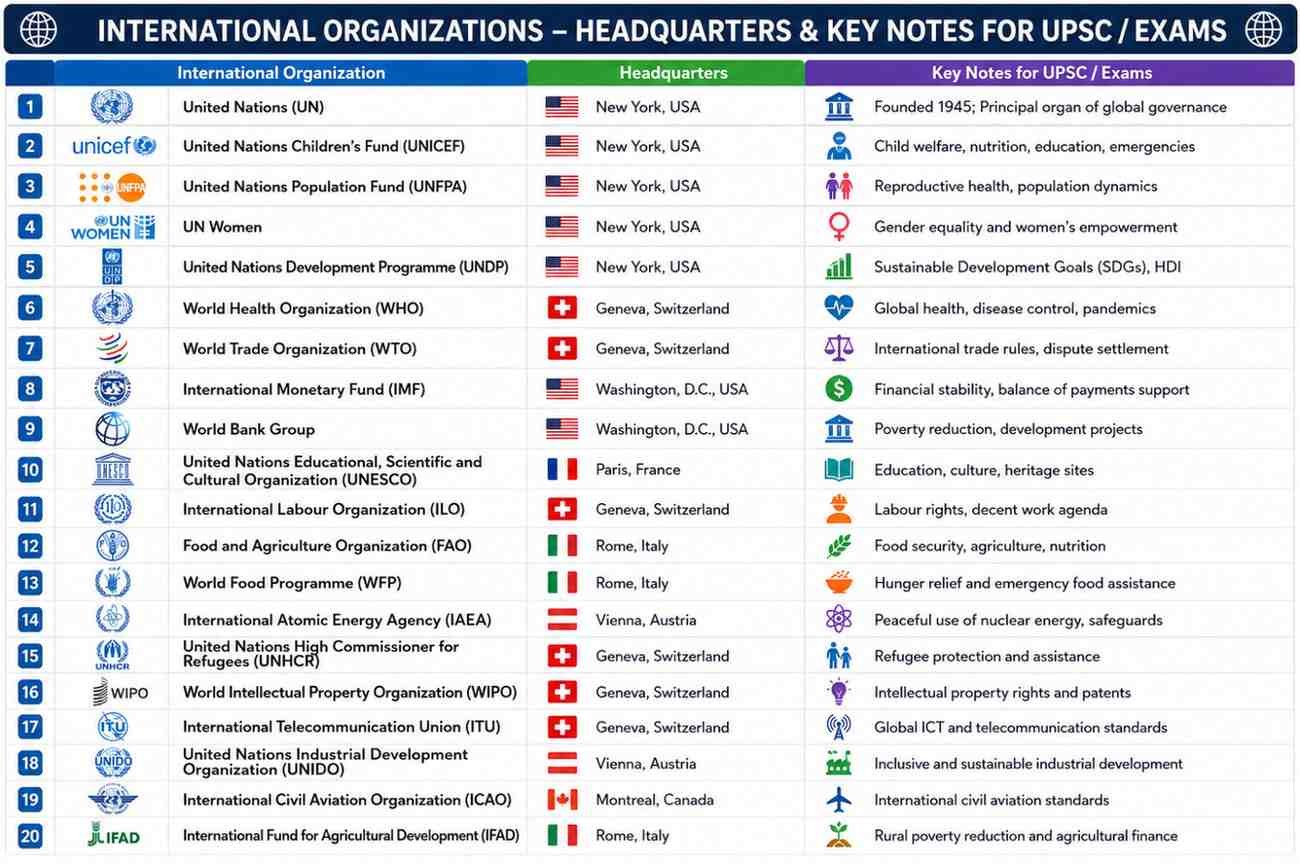
Specialized Agencies and Programmes of the UN
The UN system includes many specialized agencies (autonomous but coordinated):
- WHO – Geneva (Health)
- UNESCO – Paris (Education, Science, Culture)
- UNICEF – New York (Children)
- UNDP – New York (Development)
- FAO – Rome (Food & Agriculture)
- IMF & World Bank – Washington DC (Financial)
- WTO – Geneva (Trade)
Other important bodies: UNHCR, UNEP, UN Women, etc.
Achievements and Challenges
Achievements:
- Peacekeeping operations (over 70 missions so far).
- Eradication of smallpox, reduction in child mortality.
- Sustainable Development Goals (SDGs) – 2030 Agenda.
- Humanitarian assistance and refugee protection.
Challenges:
- Veto power of P5 limits effectiveness.
- Slow decision-making and bureaucracy.
- Funding issues (USA is the largest contributor).
- Rise of unilateralism and geopolitical tensions.
UN Reforms and India’s Position
UN reforms, especially UNSC expansion, are a major topic in UPSC.
- G4 Nations (India, Brazil, Germany, Japan) demand permanent seats.
- India strongly advocates for reformed multilateralism and greater representation from developing countries (Global South).
- India has contributed the highest number of troops to UN Peacekeeping missions.
India and the UN:
- Founding member of the UN.
- Key role in decolonization and NAM (Non-Aligned Movement).
- Active participant in UNGA, UNSC (as non-permanent), and SDGs.
- India’s contributions: Yoga International Day (June 21), International Day of Non-Violence, etc.
Conclusion
The United Nations remains the central platform for global governance despite its limitations. For India, active and constructive engagement with the UN is vital for its aspirations of becoming a permanent member of the UNSC and playing a leading role in the multipolar world order.